If you discover an unauthorized SIM registered against your CNIC, experience a SIM-swap attack, or lose money because someone misuses your mobile identity, it is important to document the incident and report it through the appropriate official channels. Knowing how to file an FIR for SIM fraud in Pakistan can help you organize your evidence, explain the incident clearly, and understand which authority may need to be contacted.
This guide explains the difference between a police FIR and a cybercrime complaint, how to prepare a written application, what documents to collect, how to check your own SIM registrations, and what steps to consider if the police do not respond as expected.
It also includes a sample FIR application for SIM fraud in Pakistan that you can adapt to your circumstances. The template is for documenting genuine concerns; it does not guarantee FIR registration or a particular legal outcome.
Quick answer: If you suspect SIM fraud, secure your mobile and financial accounts, contact your mobile operator to report the suspicious SIM or unauthorized change, preserve relevant evidence, check your own SIM registration status through official methods, and submit a cybercrime complaint through the National Cyber Crime Investigation Agency (NCCIA) where appropriate. Whether a police FIR is also appropriate depends on the facts, the suspected offences, and the applicable procedure.
Table of Contents
- What Is an FIR for SIM Fraud?
- When Should You Report SIM Fraud?
- FIR vs. Cybercrime Complaint: What Is the Difference?
- How to Check Your Own SIM Registrations Before Reporting
- What to Do Immediately After Discovering SIM Fraud
- Documents Required for a SIM Fraud Complaint
- Sample FIR Application for SIM Fraud in Pakistan
- How to Report Cybercrime Through Official Channels
- What If the Police Refuse to Register an FIR?
- What Happens After You Submit Your Complaint?
- Common Mistakes to Avoid
- Frequently Asked Questions
- Official Resources and Legal Disclaimer
1. What Is an FIR for SIM Fraud?
An FIR, or First Information Report, is a formal record registered by the police in circumstances covered by the applicable criminal procedure. It records information about a reported offence and can lead to further investigation where the legal requirements are met.
SIM fraud can involve several different situations, including:
- A SIM registered using your identity information without your authorization.
- A SIM-swap incident in which your mobile service is transferred or taken over without your consent.
- Unauthorized access to your mobile account or communications.
- Misuse of your identity information to obtain a SIM card.
- Financial fraud involving compromised mobile access, account credentials, or one-time passwords (OTPs).
These incidents are not legally identical. An unfamiliar SIM registration does not automatically establish that a crime has occurred, and a SIM-related problem does not automatically mean that an FIR is the only appropriate remedy.
The first step is to establish what happened, preserve the available evidence, and identify the relevant reporting channel.
Why written documentation matters
A clear written record can help you explain:
- When you first noticed the suspicious activity.
- Which mobile number or service was affected.
- Whether you lost mobile network service.
- Whether any unauthorized financial transaction occurred.
- Which operator or financial institution you contacted.
- What reference numbers or complaint confirmations you received.
This information can help the relevant authority assess the incident and decide what action is appropriate.
2. When Should You Report SIM Fraud?
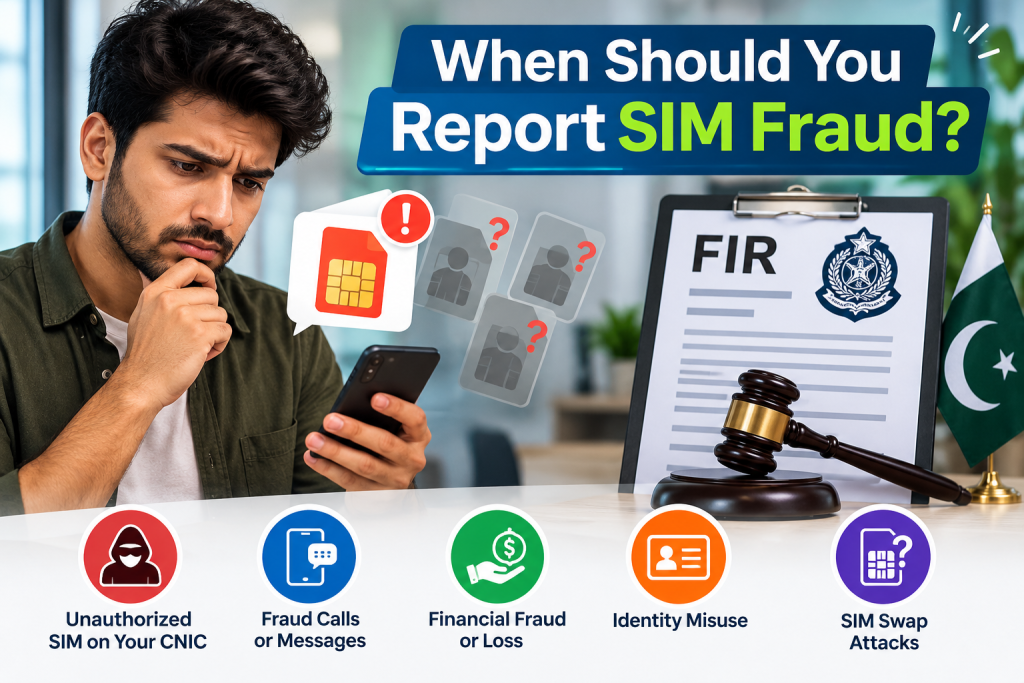
You should consider reporting a SIM-related incident when you have a reasonable basis to suspect unauthorized activity.
Situation A: An unfamiliar SIM appears against your CNIC
If your own SIM-registration check shows a number or registration you do not recognize, do not immediately assume that identity theft has been proven.
Save the result, check the details through an official channel, and contact the relevant mobile operator to ask for verification and correction of any unauthorized registration.
If the operator confirms suspicious activity or you have other evidence of identity misuse, consider reporting the matter to the appropriate authority.
Situation B: Your mobile service suddenly stops working
Unexpected loss of mobile service can have several causes, including a technical problem, a damaged SIM, an account issue, or an unauthorized SIM replacement.
Contact your operator using its verified customer-support channel. Ask whether a SIM replacement, ownership change, or other account activity took place.
If you suspect a SIM-swap attack, secure your financial and email accounts from a trusted device and contact your bank or mobile wallet provider if those accounts may be at risk.
Situation C: You discover unauthorized financial transactions
If money has been transferred from your bank account or mobile wallet without your authorization, contact the relevant bank or wallet provider immediately through its official fraud-reporting channel.
Request that the incident be recorded and ask what protective measures are available. Save transaction IDs, dates, amounts, and complaint reference numbers.
Report suspected cybercrime through NCCIA when the circumstances fall within its remit. Ask the relevant authorities or a qualified lawyer whether a police FIR or another legal application is appropriate for your specific case.
Situation D: Your number or identity is being misused
If you discover that your mobile number or identity information has been used for fraudulent messages, impersonation, threats, or other suspected offences, preserve the original messages, relevant account details, dates, and supporting records.
Avoid publicly accusing a particular person unless the facts have been properly established. Provide the available evidence to the relevant authority instead.
3. FIR vs. Cybercrime Complaint: What Is the Difference?
People often use the terms “FIR” and “cybercrime complaint” interchangeably, but they refer to different processes.
| Feature | Police FIR | NCCIA cybercrime complaint |
|---|---|---|
| Main purpose | Formal police record of information about a suspected offence where FIR registration applies | Reports suspected cybercrime for assessment and possible inquiry or investigation |
| Where to start | Relevant police station or through the applicable legal procedure | Official NCCIA complaint channels |
| Information to prepare | Written account, dates, identities where known, and supporting evidence | Written application, contact details, CNIC copy and evidence as specified by NCCIA |
| What it guarantees | Registration and investigation depend on the applicable legal requirements | Submission does not guarantee that a particular action or outcome will follow |
| Best next step | Ask about the appropriate procedure for the reported offence | Follow NCCIA’s official instructions and retain the complaint reference |
The official NCCIA website identifies NCCIA as the authorized agency for inquiries, investigations, and prosecutions under Section 29(1) of PECA as amended in 2025. Its FAQ lists the NCCIA complaint form, Pakistan Citizen Portal, email, and Cybercrime Reporting Centres as complaint routes.
Official references:
- NCCIA website: https://www.nccia.gov.pk/
- NCCIA complaint portal: https://complaint.nccia.gov.pk
- NCCIA FAQs: https://www.nccia.gov.pk/faqs.php
- NCCIA offices: https://www.nccia.gov.pk/Offices
Important: Do not assume that every cybercrime complaint must result in a separate police FIR, or that every SIM-fraud incident requires identical procedures. The appropriate route depends on the facts and applicable law.
4. How to Check Your Own SIM Registrations Before Reporting

A useful part of preparing a SIM fraud complaint is checking the registrations associated with your own CNIC through official methods.
This self-check can help you identify a possible discrepancy and gather information for a report. It is not a substitute for operator verification or an official investigation.
Method 1: Use the PTA 668 SMS service
Pakistan’s 668 service is commonly used to check SIM-registration information associated with a person’s own CNIC.
- Open the SMS application on your phone.
- Follow the current instructions published by the Pakistan Telecommunication Authority (PTA) for the 668 service.
- Send the required CNIC information in the prescribed format.
- Review the response and compare the registration counts with your own mobile connections.
- Save the response and note the date and time.
Check the current procedure and any applicable charges through official PTA information before using the service.
PTA website: https://www.pta.gov.pk/
Method 2: Use PTA’s official SIM information system
You can also visit the official SIM information website:
Use the service only to check your own registration information or information you are legally authorized to access. Review the website’s current instructions before submitting your details.
Method 3: Contact the mobile operator
If the result is unfamiliar, contact the relevant mobile operator through its official website, helpline, or service centre.
Explain that you are checking registrations associated with your own CNIC and ask the operator to verify the disputed entry and explain the process for correcting or blocking an unauthorized connection.
Keep the complaint reference number and any written response.
What should you do if the result looks wrong?
Use this practical self-check:
- I checked my own SIM registration information through an official method.
- I identified the entry or registration count that appears incorrect.
- I recorded the date and time of the check.
- I contacted the relevant operator for verification.
- I saved the operator’s complaint reference.
- I secured my mobile, email, banking, and wallet accounts if they may be affected.
- I preserved relevant evidence before submitting a complaint.
An unfamiliar result should be verified before you describe it as confirmed identity theft. Registration information may require clarification from the operator or the relevant authority.
5. What to Do Immediately After Discovering SIM Fraud
Taking the right steps early can help protect your accounts and preserve evidence.
Step 1: Secure your mobile account
Contact your mobile operator through a verified channel. Explain whether you suspect unauthorized registration, a SIM replacement, a transfer, or loss of service.
Ask what account-protection measures are available and request a complaint reference.
Step 2: Protect your financial accounts
If you suspect that an attacker may have accessed your OTPs, banking credentials, or mobile wallet:
- Contact your bank or wallet provider immediately.
- Ask whether the affected account can be temporarily restricted or secured.
- Change relevant passwords from a trusted device.
- Review recent transactions and account activity.
- Follow the provider’s official fraud-reporting process.
Do not wait for an FIR before alerting a financial institution to a suspected unauthorized transaction.
Step 3: Preserve evidence
Keep copies of the 668 response, relevant SMS messages, operator communications, transaction records, account alerts, and complaint confirmations.
Preserve original electronic records wherever possible. Do not edit screenshots in a way that changes their meaning, and do not delete potentially relevant messages before saving them.
Step 4: Submit a complaint through the appropriate channel
For suspected cybercrime, consult NCCIA’s current instructions and submit the requested documents. If the incident also involves a police-reportable offence or another legal issue, ask the relevant police station or a qualified lawyer about the applicable process.
Step 5: Keep a written timeline
Prepare a short chronology showing when the incident began, when you discovered it, which organizations you contacted, and what each organization said.
A timeline can make a complicated incident easier to explain.
6. Documents Required for a SIM Fraud Complaint
The documents needed depend on the incident and the authority receiving the complaint.
NCCIA’s published FAQ identifies three core items:
- A written application containing your name, address, city, and contact details.
- A copy of your CNIC.
- A copy of the supporting evidence.
Check the latest NCCIA instructions before visiting a reporting centre, as additional information may be requested.
Additional evidence that may help
Depending on your case, consider preparing:
- The relevant 668 response or official SIM-check result.
- The date and time when you discovered the discrepancy.
- The affected mobile number and operator, if known.
- The mobile operator’s complaint reference and response.
- Bank or mobile wallet statements showing disputed transactions.
- Transaction IDs, dates, and amounts.
- Relevant SMS messages, emails, or account-security alerts.
- Evidence of unexpected network loss or an unauthorized SIM replacement.
- Your NCCIA complaint reference, if one has already been issued.
- A written timeline of events.
Only include records that are relevant to your incident. If a document contains unrelated private information, ask the receiving authority how to submit the necessary material securely.
Privacy reminder: Do not post your full CNIC number, bank statements, OTPs, passwords, or private SIM-registration information publicly or in website comments.
7. Sample FIR Application for SIM Fraud in Pakistan
The following is a general sample application. Replace the placeholders with accurate information and remove any statement that does not apply to your case.
Do not include a legal section simply because it appears in an online template. The correct provisions depend on the conduct and evidence involved.
To:
The Station House Officer (SHO)
[Name of Police Station]
[City, Province]
Subject: Application Regarding Suspected SIM Fraud and Unauthorized Use of Identity Information
Respected Sir/Madam,
I, [Full Name], son/daughter of [Parent’s Name], residing at [Address], wish to report a suspected SIM-related incident involving my identity information.
On [date], I discovered that [describe the specific issue, such as an unfamiliar SIM registration, an unauthorized SIM replacement, loss of mobile service, or suspicious account activity]. I did not knowingly authorize the activity described below.
The relevant details are:
- Affected mobile number or service: [Insert details, if applicable]
- Mobile operator: [Insert operator, if known]
- Date and time discovered: [Insert date and time]
- Description of the incident: [Explain what happened in chronological order]
- Evidence available: [List relevant records, messages, screenshots, or statements]
- Operator complaint reference: [Insert reference, if available]
- Financial loss, if any: [Explain the amount and transaction details, or write “No known financial loss”]
I have taken the following steps, where applicable:
- Contacted the mobile operator on [date].
- Checked my own SIM-registration information through [official method].
- Contacted my bank or mobile wallet provider on [date], if relevant.
- Submitted a cybercrime complaint to NCCIA on [date], if applicable, under reference number [reference].
I request that this application be received and assessed in accordance with the applicable law and procedure. If the facts disclose an offence requiring registration of an FIR, I request that the matter be dealt with accordingly and that the available evidence be considered.
I am willing to provide further information and cooperate with the relevant investigation. The information in this application is true to the best of my knowledge and belief.
Applicant details
Full name: [Full Name]
CNIC: [Provide through the official process]
Address: [Residential Address]
Contact number: [Contact Number]
Date: [Date]
Signature: [Signature]
Attachments, as applicable
- Attachment A: SIM-registration check result
- Attachment B: Mobile operator complaint record
- Attachment C: Relevant messages or account alerts
- Attachment D: Bank or wallet transaction records
- Attachment E: NCCIA complaint confirmation
- Attachment F: Written timeline and other relevant evidence
How to use this template correctly
- State what you personally observed and what another organization confirmed.
- Separate confirmed facts from suspicions.
- Do not identify an accused person without a reasonable factual basis.
- Do not invent dates, transaction details, complaint numbers, or legal provisions.
- Ask the receiving authority what additional forms or documents are required.
- Keep a copy of the application and record the date it was submitted.
This is a sample written application, not a guarantee that the police will register an FIR in every case. A qualified lawyer can advise whether your facts support an FIR application and which legal provisions are relevant.
8. How to Report Cybercrime Through Official Channels
For a suspected cybercrime connected to SIM fraud, consult the current NCCIA reporting procedure.
Option 1: NCCIA complaint portal
Visit:
Follow the portal’s instructions, describe the incident accurately, and attach the requested supporting documents. Save the confirmation or reference number if one is provided.
Option 2: Pakistan Citizen Portal
NCCIA also lists the Pakistan Citizen Portal as a complaint route:
Check the available categories and current submission instructions to ensure that your complaint reaches the appropriate channel.
Option 3: Visit a Cybercrime Reporting Centre
NCCIA publishes office and reporting-centre information here:
Its FAQ says a complainant is generally required to visit a Cybercrime Reporting Centre for verification under the procedure referenced there. Requirements can vary with the complainant’s circumstances, so check the latest official guidance before travelling.
Option 4: Email or contact NCCIA
NCCIA’s official website publishes its contact information and email address. Use the details currently displayed on its website rather than relying on an address copied from an old third-party article.
Official website: https://www.nccia.gov.pk/
What if you are outside Pakistan?
NCCIA’s published FAQ advises overseas complainants to nominate a focal person, such as a relative or legal counsel residing in Pakistan, to pursue the complaint at a reporting centre. It also describes alternative routes involving INTERPOL or a Pakistani High Commission or Embassy where the complainant has no focal person in Pakistan.
Because requirements can change, confirm the current process directly with NCCIA before sending sensitive documents or arranging representation.
9. What If the Police Refuse to Register an FIR?
If the police station does not register your application, remain calm and ask for clarification about the appropriate procedure.
The legal position depends on the facts, the offence being reported, and the applicable criminal procedure. Not every complaint automatically meets the legal threshold for FIR registration.
Consider the following steps:
Step 1: Keep a copy of your application
Save the written application and any acknowledgment, diary entry, receipt, or reference provided by the police station.
If no acknowledgment is offered, record the date of your visit and the information you were given. Avoid making unsupported accusations about the reason for refusal.
Step 2: Ask which procedure applies
Explain the facts clearly and ask whether the matter should be recorded as an FIR, referred to another authority, or handled through another legal procedure.
If the incident involves suspected electronic crime, consult NCCIA’s current guidance as well.
Step 3: Seek advice from a qualified lawyer
If you believe the law requires further action and your application is not being addressed, a lawyer familiar with criminal procedure and cybercrime can review the facts and advise on the available remedies.
Depending on the circumstances and applicable law, legal remedies may include approaching a senior police officer or seeking relief through the competent court.
Step 4: Verify the applicable legal provisions
Do not rely on a generic online template to determine whether an offence is cognizable, which authority has jurisdiction, or whether a particular section applies.
The Prevention of Electronic Crimes Act, 2016, as amended, and the Code of Criminal Procedure may both be relevant. The exact provisions depend on the facts.
10. What Happens After You Submit Your Complaint?
The next steps depend on the authority, the nature of the alleged offence, and the evidence available.
Possible steps include:
- Initial review: The authority reviews the application and available information.
- Request for clarification: You may be asked to provide additional records or explain specific details.
- Inquiry or investigation: Where legally appropriate, the competent authority may investigate the reported conduct.
- Requests for relevant records: Investigators may seek records from service providers through the applicable legal process.
- Further legal action: The matter may proceed according to the evidence and the relevant legal requirements.
There is no universal timeline that guarantees when a SIM-fraud complaint will be resolved. Keep your reference numbers, respond to legitimate requests, and follow up through the official channel.
If money was lost
Continue communicating with your bank or mobile wallet provider separately. A cybercrime complaint and a financial-service dispute are not necessarily the same process.
Ask the financial institution which records it requires to assess the unauthorized transaction. Do not assume that an FIR is always mandatory for every reversal request; requirements depend on the institution, the payment method, and the applicable rules.
11. Common Mistakes to Avoid When Reporting SIM Fraud
Mistake 1: Treating an unfamiliar registration as conclusive proof
An unfamiliar SIM entry should be verified with the operator. Describe it as a suspected unauthorized registration until the facts are confirmed.
Mistake 2: Waiting to secure financial accounts
If you suspect an account takeover or OTP interception, contact your financial institution promptly instead of waiting for a complaint to be processed.
Mistake 3: Deleting original evidence
Preserve relevant messages, transaction records, and account alerts. Keep original files where possible.
Mistake 4: Using outdated reporting instructions
Older online articles may refer to a previous agency or an outdated complaint portal. Check NCCIA’s official website for current cybercrime reporting guidance.
Mistake 5: Copying legal sections without checking them
The relevant offence depends on what happened. For example, unauthorized use of identity information and unauthorized SIM issuance are addressed differently under PECA. A legal professional should assess which provisions, if any, apply to your circumstances.
Mistake 6: Sharing private information publicly
Never publish your full CNIC, bank details, passwords, OTPs, or sensitive complaint documents on social media or public websites.
Mistake 7: Expecting one complaint to resolve every issue
You may need to contact the mobile operator, the bank or wallet provider, NCCIA, or the police for different aspects of the incident. Keep each reference number and track each matter separately.
12. Frequently Asked Questions
How do I file an FIR for SIM fraud in Pakistan?
Start by documenting the incident, securing affected accounts, and contacting your mobile operator. For suspected cybercrime, consult NCCIA’s official reporting instructions. If you believe a police FIR is appropriate, submit a clear written application to the relevant police station and seek legal advice if the applicable procedure is unclear.
Can I report an unknown SIM registered against my CNIC?
Yes. You can ask the relevant mobile operator to verify the registration and report suspected unauthorized use through the appropriate official channel. An unfamiliar entry alone does not establish who registered it or whether a criminal offence occurred.
What documents are needed for a SIM fraud complaint?
NCCIA lists a written application with your name, address, city, and contact details, a CNIC copy, and a copy of the evidence. Additional documents may be useful depending on the incident.
Do I need an FIR before contacting NCCIA?
Do not delay reporting suspected cybercrime merely because you have not obtained a police FIR. NCCIA publishes its own complaint channels. Whether a separate FIR is appropriate depends on the circumstances and applicable law.
Does every SIM fraud case fall under PECA Section 16?
No automatic conclusion should be made. Section 16 concerns unauthorized use of identity information, while Section 17 addresses unauthorized issuance of SIM cards and related conduct. Which provision applies depends on the facts and the statutory requirements.
Can I report SIM fraud if I do not know who did it?
You can report the facts and state that the responsible person is unknown. Do not guess or accuse a specific individual without evidence. The relevant authority can assess what further inquiry is appropriate.
What should I do if my SIM suddenly stops working?
Contact your operator through a verified channel and ask whether a SIM replacement, transfer, or account change occurred. If you suspect a SIM-swap attack, secure your financial and email accounts and report unauthorized transactions immediately.
Can I file a complaint from outside Pakistan?
NCCIA’s published FAQ describes a process involving a focal person residing in Pakistan and outlines alternatives where no focal person is available. Confirm the latest requirements directly with NCCIA.
How long does an FIR or cybercrime investigation take?
There is no single reliable timeline for every case. The time required depends on the incident, the available evidence, the responsible authority, and the steps needed for investigation.
Is a lawyer required to prepare an FIR application?
A person may be able to prepare a written account without a lawyer, but legal advice can be useful where the facts are complex, substantial financial loss is involved, or there is uncertainty about jurisdiction and procedure.
13. Official Resources for SIM Fraud and Cybercrime in Pakistan
Use official sources to verify current procedures and legal information:
- National Cyber Crime Investigation Agency (NCCIA): https://www.nccia.gov.pk/
- NCCIA complaint portal: https://complaint.nccia.gov.pk
- NCCIA FAQs: https://www.nccia.gov.pk/faqs.php
- NCCIA offices: https://www.nccia.gov.pk/Offices
- Pakistan Telecommunication Authority (PTA): https://www.pta.gov.pk/
- PTA SIM information system: https://cnic.sims.pk/
- Official Gazette of Pakistan — PECA Amendment Act 2025: https://www.na.gov.pk/uploads/documents/679b243193585_457.pdf
- Consolidated PECA text for reference: https://statutes.pk/peca
The consolidated text at Statutes of Pakistan is a secondary legal resource; verify legal citations against the official Gazette and applicable current law.
Final Thoughts
If you suspect SIM fraud in Pakistan, take practical steps rather than relying on assumptions. Check your own SIM registration through an official method, contact your mobile operator, secure any affected financial accounts, preserve the evidence, and report suspected cybercrime through the appropriate official channel.
A well-organized application should explain what happened, when it happened, what you personally observed, and which supporting records are available. It should not exaggerate the facts or assume that a specific legal section automatically applies.
For ongoing self-checks, use official SIM-verification resources and keep your CNIC and account information private. If the incident involves significant financial loss, identity misuse, or a disputed legal procedure, seek advice from a qualified professional.
Editorial note: This article provides general educational information, not legal advice. Laws, reporting procedures, and agency requirements may change. Verify current instructions with the relevant official authority before submitting a complaint.
Leave a Reply