Introduction
Mobile phones have become an essential part of everyday life in Pakistan. People use their numbers for personal communication, online banking, digital wallets, social media accounts, business activities, and important verification messages. However, many users overlook one important question: is the SIM card they use officially registered under their own identity?
SIM ownership is more than simply possessing a mobile number. It concerns the subscriber information recorded by a mobile network and the responsibility attached to that registration. A person may use a number for years without realizing that the official record still identifies another individual as its registered owner.
This situation can create difficulties when a user needs a replacement SIM, wants to resolve a registration issue, or must establish control over a number connected to important accounts. It can also create risks when a mobile connection is lost, shared, or used without the registered subscriber’s knowledge.
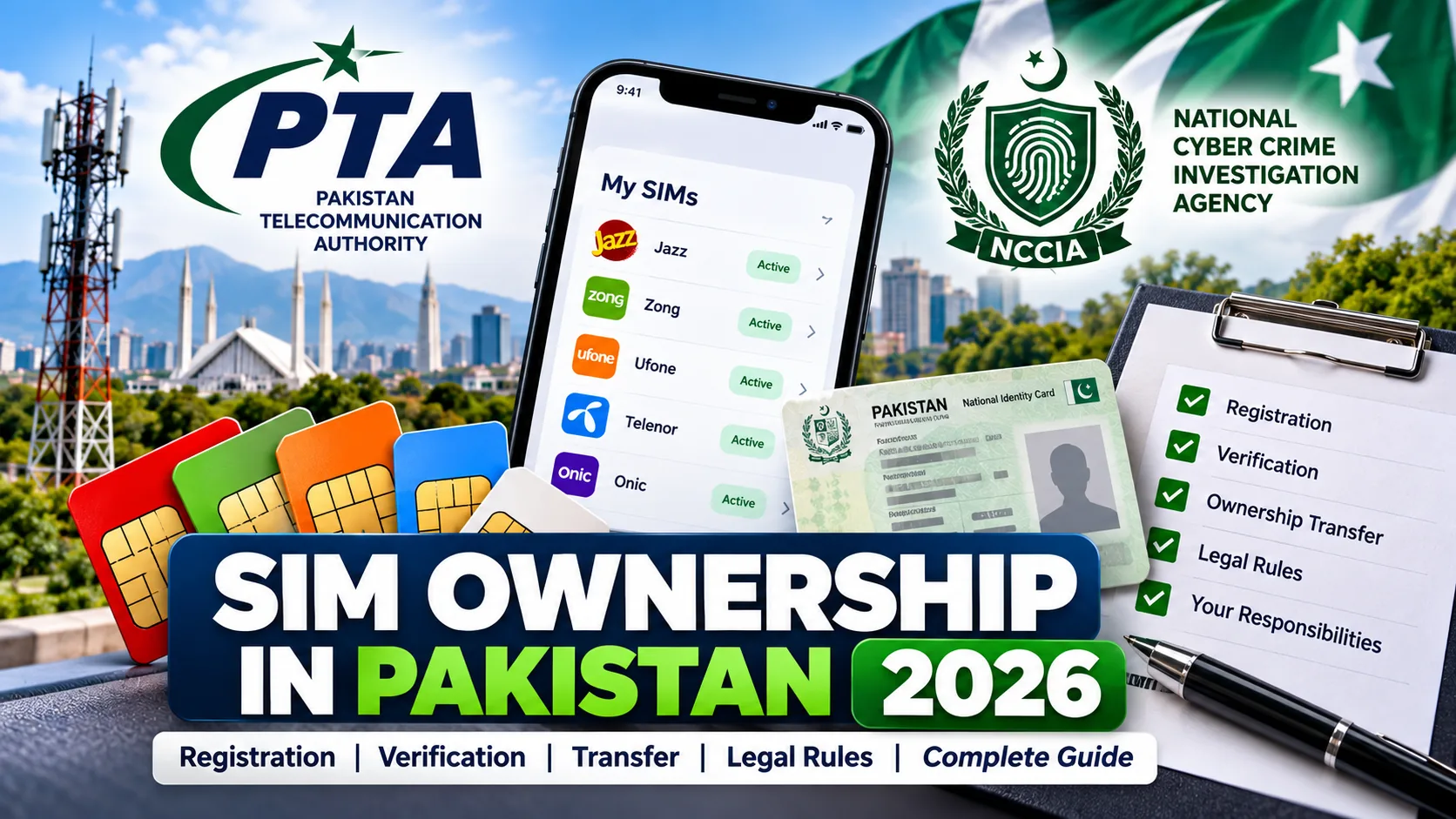
This guide explains SIM ownership in Pakistan, including registration procedures, biometric verification, ownership transfers, CNIC verification, common problems, and practical safety measures. It is designed as an educational self-check guide for people who want to understand and manage their own mobile connections responsibly.
For official guidance, users should consult the Pakistan Telecommunication Authority (PTA) and the relevant mobile network operator.
1. What Is SIM Ownership?
SIM ownership refers to the subscriber registration associated with a mobile connection. When a SIM is issued, the mobile operator records the required identification information and completes the applicable verification process. The resulting record identifies the person officially associated with that connection.
A SIM card itself is a small component that enables a compatible device to connect to a mobile network. The mobile number is the communication identity associated with the service, while subscriber registration connects that service to an identified user.
These concepts are related, but they are not interchangeable.
For example, a person may possess a SIM card, receive calls on it, and pay its monthly charges. Nevertheless, those activities alone do not establish that the number is registered under that person’s CNIC.
Similarly, a person who purchased a phone second-hand might receive a SIM from the previous owner without completing a formal ownership change. The new user could then encounter difficulties if the registered subscriber must complete a verification procedure.
The key principle is that physical possession and official registration are different things. Users should confirm their own registration status instead of assuming that long-term use automatically establishes ownership.
2. Why SIM Ownership Matters in Pakistan
Correct registration helps establish accountability for mobile connections. It also gives subscribers a clearer way to manage their numbers when changing devices, replacing damaged SIM cards, or addressing unauthorized activity.
There are several practical reasons to maintain accurate SIM ownership records.
Personal accountability
A registered subscriber may be held responsible for the use or misuse of a connection under applicable rules. In December 2025, PTA publicly reminded consumers to register SIMs in their own names and verify the connections associated with their CNICs.
This makes accurate registration particularly important for people who lend their SIM cards to others or continue using numbers registered under relatives’ or friends’ identities.
Protection against unauthorized registration
If someone uses your identity information to obtain a mobile connection without your knowledge, the registration could create an administrative problem that requires investigation and correction.
Regularly reviewing your own SIM registration status can help you identify unexpected records sooner.
Easier account recovery
Many online services send one-time passwords and security notifications to registered phone numbers. Losing control of a number may therefore affect access to email, banking, social media, and other accounts.
Keeping your mobile registration accurate is one part of maintaining control over these communication channels.
Better control of unused connections
Old numbers may remain associated with an individual’s identity even after they stop using them. Reviewing existing registrations helps users identify connections that require attention.
PTA has encouraged consumers to retain only the connections they need and to contact the relevant operator if they discover a SIM they did not authorize.
3. SIM Ownership vs SIM Registration
The expressions SIM ownership and SIM registration are often used together, but they describe different aspects of a mobile connection.
SIM registration refers to the process through which the mobile operator records subscriber information and verifies the applicant according to applicable requirements.
SIM ownership describes the official subscriber association resulting from that registration. It is commonly used when discussing who is recorded as responsible for a particular connection.
Consider three examples:
- A customer visits an authorized operator outlet, completes the required verification, and receives a new SIM. Registration establishes the subscriber record for that connection.
- A person regularly uses a number registered under a family member’s name. Everyday use does not automatically update the operator’s registration record.
- A customer formally requests an ownership change and completes the operator’s required procedure. The record can then be updated according to the operator’s rules.
This distinction is important when searching for SIM Owner Details. The information needed for a self-check is not necessarily the same as the private subscriber information held by a telecom company.
Users should rely on authorized verification channels and official customer-service procedures rather than unofficial websites claiming to reveal private subscriber records.
4. How SIM Registration Works in Pakistan
Mobile SIM registration involves identity verification and the creation of a subscriber record by the relevant mobile network operator.
For Pakistani citizens, a valid CNIC is generally central to the standard registration process. The exact requirements can depend on the transaction, the applicant’s circumstances, and the operator’s current procedures.
A typical process includes the following stages.
Step 1: Visit an authorized sales outlet
Choose an official customer service centre, authorized franchise, or other operator-approved location that provides the service you need.
Avoid purchasing connections through suspicious sellers who offer registration without proper identification or verification.
Step 2: Present the required identification
Bring your original, valid identity document and any additional documents requested by the operator.
A photograph of an identity card or an informal message containing identification details should not be treated as a substitute for the operator’s required verification process.
Step 3: Complete biometric verification
Where required, the operator will perform biometric verification through its authorized system. Follow the instructions given at the service location.
PTA has described biometric verification procedures for SIM issuance and related activities, including duplicate SIM issuance, ownership changes, re-verification, and mobile number portability.
Step 4: Wait for confirmation
The operator must complete its prescribed checks before the transaction can be finalized. If verification fails, ask the staff to explain the issue and the official next steps.
Do not assume that receiving a physical SIM card means every registration requirement has been completed successfully.
Step 5: Keep a record of the transaction
Retain any receipt, reference number, or confirmation message provided by the operator. These details may help if a registration problem arises later.
For current requirements, consult the operator directly because procedures and restrictions can change.
5. How to Check SIMs Registered Against Your Own CNIC
One of the most useful parts of managing SIM ownership is reviewing the connections associated with your own identity.
PTA provides an official SIM Information System through which users can check the number of SIMs registered against their CNIC across mobile networks.
Method 1: Use the official PTA SIM Information System
Follow these steps:
- Open the official portal: https://cnic.sims.pk/
- Follow the on-screen instructions for CNIC verification.
- Enter your own CNIC information as requested.
- Complete the displayed verification step, if applicable.
- Review the results showing the available SIM registration information.
Use the official domain rather than a copied link from an unfamiliar website.
The portal is intended to help users review SIM registration information. Do not assume that a count of connections will always reveal the full mobile number or the complete identity details associated with each SIM.
Method 2: Check through SMS
PTA has also advised consumers that they can send their CNIC number without dashes to 668 to check the SIM count associated with their identity. Charges may apply.
Before sending a message, verify the current procedure and any applicable charges through official PTA guidance or your operator.
What should you do with the results?
Review the returned information carefully. If the number of connections appears unfamiliar or does not match your records, do not immediately assume that fraud has occurred. There may be an old connection, a record you have forgotten, or a registration issue requiring clarification.
Contact the relevant mobile operator through an official service channel and ask how to verify the discrepancy.
For a broader self-check, you can also read the related guide on SIM Owner Details Online in Pakistan. Replace this example link with the exact published article URL if your permalink is different.
6. Understanding Biometric Verification
Biometric verification helps confirm that a person requesting a SIM-related service is the individual identified through the authorized verification process.
In Pakistan, biometric checks have an important role in mobile connection issuance and other transactions where subscriber verification is required.
The process generally involves presenting the necessary identification and providing the requested fingerprint impressions through an authorized system. The system checks the submitted biometric information according to the applicable procedure.
Why biometric checks are important
Biometric verification is designed to reduce unauthorized SIM issuance and strengthen confidence in the identity of the person completing a transaction.
It can be relevant when:
- Applying for a new mobile connection.
- Requesting a duplicate SIM.
- Changing the registered subscriber.
- Completing a re-verification procedure.
- Requesting mobile number portability where the prescribed process requires it.
Not every transaction follows an identical workflow, so customers should confirm the requirements with their network operator.
What if biometric verification fails?
A failed verification does not necessarily mean that a person’s identity is invalid. Fingerprint quality, document issues, system availability, or differences in the recorded information may require further checks.
Ask the authorized service centre to explain the failure and identify the approved procedure for resolving it. If necessary, seek assistance from the relevant identity authority or operator.
Never pay an unofficial agent who promises to bypass the verification system.
7. How to Transfer SIM Ownership Legally
Ownership transfer may become necessary when a number is registered under another person’s name but is intended to be used by a different individual.
For example, a person might continue using a number originally obtained by a parent, spouse, friend, or former employee. If the registered subscriber changes, the correct approach is to ask the operator about its formal ownership-transfer process.
Step 1: Contact the mobile operator
Visit the official website or customer service centre of the network providing the connection. Ask about the current change-of-ownership requirements.
Do not rely on instructions intended for a different operator because documentation and transaction conditions can vary.
Step 2: Confirm the required documents
The operator may require valid identification from the existing registered subscriber and the proposed new subscriber. Additional documents or conditions may apply depending on the circumstances.
Ask the operator whether both parties must attend in person and what happens if the original subscriber is deceased, unavailable, or otherwise unable to participate.
Step 3: Complete the prescribed verification
Where required, both parties must complete the relevant identity and biometric checks. The operator must confirm that the request satisfies its rules before changing the registration.
Never attempt to use another person’s fingerprints, identity document, or verification credentials.
Step 4: Obtain confirmation
Ask for a receipt, reference number, or other confirmation of the request. If the operator approves the change, confirm when the updated registration will take effect.
Step 5: Verify your own record
After the transfer has been processed, check your own SIM registration status through the official PTA system or the operator’s approved channel.
If the information does not appear to be correct, contact the operator instead of submitting repeated requests without understanding the cause.
Important: Ownership transfer is not simply a matter of handing over a SIM card. The registered subscriber information must be handled through the operator’s authorized procedure.
8. What If a SIM Is Registered in Your Name Without Your Permission?
Discovering an unfamiliar SIM registration can be worrying, but the most useful response is to document the issue and report it through official channels.
First, verify the information
Check the result again and make a note of the network and the nature of the discrepancy. A SIM count may not provide enough detail to identify the connection on its own.
Avoid sharing your full CNIC publicly while seeking advice online.
Contact the relevant operator
Explain that the registration appears unfamiliar or unauthorized. Ask the operator to investigate the record and advise you about the required complaint process.
Keep any complaint number or written response for your records.
Escalate unresolved issues
If the operator does not resolve the matter, consider submitting a complaint through PTA’s official complaint system:
Describe the issue clearly, include the operator’s response where available, and attach only the documents requested through the official process.
Report suspected identity misuse
If you have evidence suggesting identity theft, fraudulent SIM issuance, threats, or related criminal activity, consider reporting the matter to the appropriate law-enforcement authority.
Do not publicly accuse a specific individual without reliable evidence. Allow the relevant authority to investigate the circumstances.
For additional reading, connect this section to your article about incorrect SIM registrations and the steps users can take to resolve them.
9. SIM Ownership for Foreign Nationals in Pakistan
Foreign nationals may have different documentation requirements from Pakistani citizens when obtaining a mobile connection.
The applicable procedure can depend on the person’s immigration status, identity documents, and the mobile operator’s current rules. A foreign passport, visa or other relevant documentation may be required, depending on the circumstances.
Visitors should therefore confirm the requirements with an authorized network outlet before purchasing a SIM.
Before applying
- Ask which identity documents are accepted for your situation.
- Confirm whether the operator requires biometric or other verification.
- Check any applicable validity conditions.
- Keep the registration receipt and supporting documents.
- Ask how to manage or discontinue the connection when it is no longer needed.
Foreign visitors should not assume that a procedure designed for a Pakistani CNIC holder will automatically apply to them.
Likewise, people living in Pakistan on a longer-term basis should ask the operator about the appropriate registration route for their documents.
If your site has a dedicated guide for foreign nationals, link that guide here using its exact published URL. This gives readers more specific information without repeating the entire registration process in multiple articles.
10. Responsibilities of a Registered SIM Owner
Registering a connection creates responsibilities that continue after the SIM is activated.
The subscriber should take reasonable steps to maintain accurate records, protect the SIM, and ensure that the number is not used in a way that violates applicable rules.
Keep the connection under your own identity
Avoid relying indefinitely on a number registered under another person’s name. Ask the operator about the proper transfer process when a change is needed.
Protect access to the SIM
Keep your phone and SIM secure. Use the available device-lock and account-security features, and contact your network promptly if the SIM is lost or stolen.
Avoid careless sharing
Giving someone access to your number can affect your privacy and account security. Think carefully before lending a SIM, sharing verification messages, or allowing another person to use your number for account registration.
Monitor important accounts
If your number is linked to financial services or other sensitive accounts, keep your recovery details current. Where available, use additional security options instead of depending exclusively on SMS verification.
Respond to suspicious activity
Unexpected service interruptions, unrequested verification messages, or unexplained account-recovery alerts may justify checking your account security and contacting the relevant provider.
These signs do not automatically prove SIM-related fraud, but they should not be ignored.
11. Common SIM Ownership Problems and Their Solutions
SIM ownership issues can arise for several reasons. Identifying the correct problem helps users choose the appropriate remedy.
Problem 1: The SIM is registered under a family member’s name
Possible solution: Contact the network operator and ask about transferring the registration. Follow the required verification process rather than relying on an informal agreement.
Problem 2: An old SIM still appears against your CNIC
Possible solution: Ask the relevant operator to investigate the connection and explain the available options. Do not assume an unused number has automatically disappeared from the record.
Problem 3: Biometric verification is unsuccessful
Possible solution: Request an explanation from the authorized service centre. Confirm whether your identification record, biometric capture, or another verification step needs attention.
Problem 4: The SIM has been lost or stolen
Possible solution: Contact the network operator promptly and request the appropriate blocking or replacement procedure. Follow its identity-verification requirements.
If the number is connected to banking or digital wallets, contact those service providers as appropriate to protect your accounts.
Problem 5: The SIM count does not match your expectations
Possible solution: Recheck your details and contact the relevant operator for clarification. If the issue remains unresolved, use the official PTA complaint channel.
Problem 6: The operator’s record appears incorrect
Possible solution: Provide the supporting information requested through the official complaint process. Retain reference numbers and responses so the issue can be followed up properly.
In every case, avoid unofficial services claiming that they can modify telecom records or bypass identity verification.
12. How to Protect Your CNIC and SIM Information
SIM ownership and identity protection are closely connected. A person who obtains sensitive identity information may attempt to misuse it, although possession of a CNIC number alone does not prove that a SIM has been issued fraudulently.
The following habits can reduce unnecessary exposure.
Use official channels. Enter CNIC information only on verified government, regulator, or operator services when required.
Avoid suspicious lookup websites. Be cautious of sites claiming to provide complete subscriber records, call histories, live locations, or private identity details. Such claims may be misleading, unlawful, or designed to collect personal information.
Do not share verification codes. One-time passwords and account-recovery codes should remain private. A caller claiming to represent a telecom company should not be given sensitive codes without a legitimate, verified reason.
Be careful with identity documents. Do not send CNIC images to unknown sellers or social media accounts. If an organization genuinely needs a document, confirm its identity and purpose first.
Secure your phone. Use a strong device lock and keep your software updated. Review account recovery settings and sign out of accounts on devices you no longer use.
Check your registration periodically. A self-check can help you spot discrepancies and take action before they become more difficult to resolve.
Report suspicious requests. If someone pressures you to provide fingerprints, identity documents, or verification codes for an unclear purpose, stop and contact the relevant organization through an official channel.
These precautions are practical steps, not a guarantee against every form of identity misuse.
13. Frequently Asked Questions About SIM Ownership in Pakistan

What does SIM ownership mean?
SIM ownership refers to the official subscriber association recorded for a mobile connection. It is different from simply possessing or using the SIM card.
How can I check SIMs registered against my CNIC?
You can use the official PTA SIM Information System at https://cnic.sims.pk/ or follow PTA’s published SMS procedure using 668. Review your own information and confirm any discrepancies with the relevant operator.
Can I use a SIM registered under another person’s name?
PTA has advised consumers to use SIMs registered in their own names and has warned that using another person’s registered connection violates applicable procedures. Contact the operator about formalizing the registration instead of relying on long-term informal use.
How do I transfer SIM ownership?
Contact the relevant network’s authorized customer service centre. Ask about the required documents, attendance rules, biometric checks, and other conditions. Complete the official process and verify the updated record afterward.
What should I do if an unknown SIM appears against my CNIC?
Contact the relevant operator, explain the discrepancy, and request an investigation. If the issue is not resolved, consider filing a complaint through PTA’s official portal.
Is biometric verification required for SIM ownership changes?
PTA has described biometric verification as part of SIM-related transactions, including ownership changes. Confirm the current requirements with the operator handling your particular case.
Can a foreign national register a SIM in Pakistan?
Foreign nationals may be able to obtain mobile service subject to the applicable documentation and verification requirements. The precise process depends on their circumstances and the operator’s current rules.
Does a SIM count show the complete owner’s information?
A SIM-count service is intended to help users review registrations associated with their identity. It should not be assumed to provide every subscriber detail or the complete number for each connection.
Should I trust websites offering private SIM records?
Be cautious. Prefer official verification services and authorized complaint channels. Avoid sites that promise private subscriber details without a clear lawful basis.
Why should I review my SIM registration if I use only one number?
A self-check can help identify unexpected or outdated registrations that may need clarification. Maintaining accurate records also supports better account security and responsible mobile use.
14. Final Thoughts
SIM ownership is an important part of responsible mobile communication in Pakistan. A connection should not be treated as correctly registered simply because it works or has been used for a long time. The official subscriber record matters, particularly when a customer needs a replacement SIM, an ownership transfer, or help resolving an unfamiliar registration.
The practical approach is straightforward: understand your registration status, use authorized biometric and identity-verification procedures, keep your personal information secure, and contact the mobile operator when something does not match your records.
For a personal self-check, start with the official PTA SIM Information System. For unresolved registration issues, consult the relevant operator or use the official PTA complaint portal.
Accurate registration, careful handling of identity documents, and timely reporting of suspicious activity can help users maintain better control over their mobile connections and protect their digital accounts.
Leave a Reply