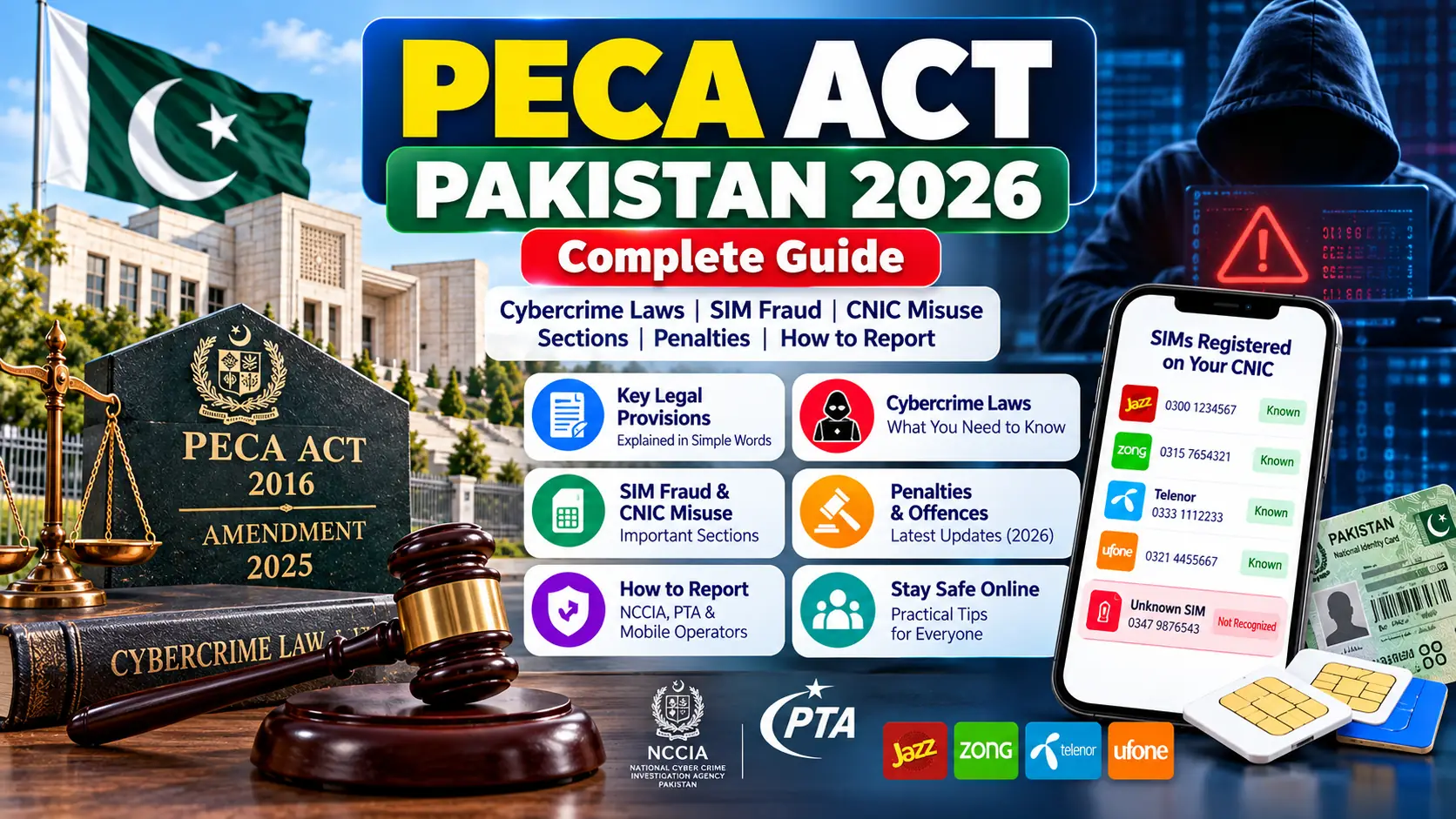
PECA Act Pakistan 2026: Cybercrime Laws, SIM Fraud and CNIC Misuse
The PECA Act Pakistan 2026 guide explains Pakistan’s cybercrime law, the legal provisions relating to identity information and unauthorised SIM issuance, and the official channels available for reporting suspected cybercrime. It also explains how to respond if you discover an unfamiliar SIM registered against your CNIC and what evidence you should prepare before making a complaint.
Pakistan’s digital services have made communication, banking, online shopping and identity verification easier. At the same time, the misuse of personal information, online impersonation, digital fraud and unauthorised SIM registration can create serious concerns for ordinary citizens.
If someone uses your identity information without permission, a mobile SIM appears against your CNIC that you do not recognise, or you experience an online fraud, understanding Pakistan’s cybercrime laws can help you decide what to do next.
The Prevention of Electronic Crimes Act, 2016, commonly known as the PECA Act, is a key part of Pakistan’s legal framework for electronic crimes. It was amended in 2025, and the National Cyber Crime Investigation Agency (NCCIA) is identified under the amended framework as the agency responsible for inquiries, investigations and prosecutions of offences under the Act.
This guide explains the law in plain English, highlights provisions relevant to SIM registration and identity misuse, and outlines how to preserve evidence and report a concern through the appropriate official channels.
Important: This article provides general legal information, not individual legal advice. The precise offence, applicable provision and potential penalty depend on the facts, evidence and current law. A suspicious event or unfamiliar SIM registration does not, by itself, prove that a crime has occurred.
What Is the PECA Act in Pakistan?
The Prevention of Electronic Crimes Act, 2016, is a Pakistani law dealing with specified offences involving information systems, electronic communications, digital information and related activities.
It provides legal provisions for particular conduct involving computers, digital accounts, personal information and online activity. It also establishes procedures and institutional arrangements for investigating and prosecuting offences covered by the Act.
The law is relevant when a problem involves conduct that may fall within a defined electronic-crime offence. However, not every online disagreement, incorrect record, failed transaction or mobile-network problem automatically constitutes a PECA offence.
The facts must be assessed against the relevant legal provision.
Why does PECA matter to ordinary mobile users?
A mobile number can be associated with account verification, financial notifications, personal communications and recovery procedures. Personal identity information may also be used in registration processes.
This creates several situations in which users may need to understand their rights and reporting options:
- A SIM registration appears against their CNIC that they cannot recognise.
- Their identity information may have been obtained or used without authorisation.
- Someone impersonates them through an electronic account or communication.
- They experience suspected online financial fraud.
- They receive threats, harassment or other communications that may involve an offence.
- They need to preserve digital evidence for an official complaint.
These situations are not legally identical. The right response depends on what happened, which organisation controls the relevant records, and whether the available evidence indicates a possible legal offence.
What Changed Under the PECA Amendment Act 2025?
The Prevention of Electronic Crimes (Amendment) Act, 2025, introduced amendments to the existing legal framework. The official Gazette publication is dated 29 January 2025. <Cite refs={[“turn439807search8″,”turn439807search1”]}/>
One important institutional change concerns the National Cyber Crime Investigation Agency.
Under Section 29 of the amended framework, NCCIA is the agency designated for inquiries, investigations and prosecutions relating to offences under PECA. Its official website publishes legal materials, complaint information and details of its reporting centres. <Cite refs={[“turn439807search0″,”turn439807search4”]}/>
For a person reporting suspected cybercrime, the practical lesson is to consult the current NCCIA reporting instructions instead of relying only on older articles that may mention earlier arrangements.
Why should you verify the current law?
Legal provisions can be amended, and an online article may describe an earlier version of the law. A section number, punishment or institutional name copied from an outdated source may therefore be misleading.
Before relying on a particular provision, consult the official Gazette, the current legal text and the relevant official agency.
For a case involving a specific alleged offence, legal advice from a qualified Pakistani lawyer may be necessary.
PECA and SIM Fraud: Understanding the Difference
A SIM registration issue can involve telecommunications records, identity verification, unauthorised use of identity information or suspected criminal activity. These possibilities should not be treated as interchangeable.
For example, a person may check their own CNIC and find an unfamiliar SIM entry. The entry is a discrepancy that should be verified. It does not independently establish who registered the SIM, whether the registration was unlawful, or whether another offence occurred.
Similarly, a mobile service interruption does not automatically prove a SIM-swap attack. It may have another explanation, and the operator should be asked to review the relevant account records.
Three different questions to ask
1. Is the SIM registration correct?
This is primarily a question for the relevant mobile operator, using its official verification and complaint procedures.
2. Has my identity information been used without authorisation?
This requires a factual assessment of what information was obtained or used, how it was used and whether the circumstances may fall within an applicable legal provision.
3. Has a cybercrime or another offence occurred?
That depends on the conduct, applicable law and evidence. Where suspected cybercrime is involved, NCCIA’s official reporting process may be appropriate.
A single incident may require more than one type of complaint. For example, an operator may need to review a SIM registration while a separate suspected electronic offence requires reporting to the relevant investigation agency.
Section 16: Unauthorised Use of Identity Information
Section 16 of PECA addresses the unauthorised use of identity information. The provision covers specified conduct involving another person’s identity information without authorisation. <Cite refs={[“turn439807search6”]}/>
In plain English, the central issue is whether someone obtained, sold, possessed, transmitted or used another person’s identity information without the required authorisation, in circumstances covered by the section.
This may be relevant when a person suspects that their personal identity details have been used improperly. However, the presence of an unfamiliar SIM registration does not automatically establish every element of a Section 16 offence.
The circumstances and evidence matter.
What should a person do if identity information may have been misused?
Start by documenting the facts you know. Record when you discovered the issue, what information appeared incorrect and which organisation provided the relevant information.
Contact the organisation responsible for the affected record and ask it to verify the discrepancy. If the facts suggest possible unauthorised use of identity information or another cybercrime, consult the official NCCIA reporting procedure.
Do not publicly accuse a particular individual without reliable evidence. An official investigation is the appropriate way to examine disputed facts.
Section 17: Unauthorised Issuance of SIM Cards
Section 17 of PECA addresses the unauthorised issuance of SIM cards and specified related modules without obtaining and verifying subscriber information in the manner approved by the Pakistan Telecommunication Authority. <Cite refs={[“turn439807search2″,”turn439807search8”]}/>
This provision is particularly relevant to discussions about SIM registration because it concerns the process by which a subscriber identity module is provided and verified.
The key legal issue is not merely whether a SIM exists. It concerns the conduct described in the statutory provision and whether the relevant legal requirements were followed.
What does this mean for a consumer?
If a SIM appears against your CNIC and you do not recognise it, you should first seek verification from the relevant mobile operator.
Ask the operator to review the registration, explain the available dispute process and advise what documentation is needed. If the circumstances indicate suspected unlawful issuance or identity misuse, preserve the relevant records and consider making a report through the appropriate official channel.
Do not assume that every unfamiliar entry proves a Section 17 offence. Determining whether a particular offence occurred requires consideration of the applicable legal elements and evidence.
What penalty is associated with Section 17?
The statutory text describes punishment of imprisonment for a term that may extend to three years, a fine that may extend to PKR 500,000, or both, for conduct covered by the provision. <Cite refs={[“turn439807search2”]}/>
These are statutory maximums, not automatic outcomes for every SIM-related complaint. Whether a provision applies and what outcome follows depend on the case and the legal process.
What Is the Difference Between Sections 16 and 17?
The two provisions address different types of conduct.
| Provision | Main subject | Practical relevance |
|---|---|---|
| Section 16 | Unauthorised use of identity information | May be relevant when personal identity information is used without authorisation |
| Section 17 | Unauthorised issuance of SIM cards and specified modules | May be relevant when a SIM is provided without the prescribed subscriber verification |
The distinction is important because an identity-information concern and a SIM-issuance concern are not necessarily the same legal issue.
A complaint should describe what actually happened instead of naming a section solely because it appears relevant in an online article. The appropriate legal provision should be assessed against the evidence and current statutory text.
Other Cybercrime Concerns Covered by PECA
PECA includes provisions addressing various categories of electronic crime. The exact section relevant to an incident depends on the conduct involved.
The following examples explain broad categories of concern. They are not a substitute for reviewing the full current law.
Unauthorised access to information systems
A person may suspect that someone accessed a computer, account or information system without permission. The important questions include what system was accessed, what actions occurred and whether the circumstances meet the relevant legal requirements.
Preserve relevant account alerts and records, secure the affected account, and report the incident through the appropriate service provider or official channel.
Unauthorised copying or transmission of data
A dispute may arise when information is copied, transferred or shared without permission. The legal assessment depends on the information involved, the conduct and the applicable provision.
Keep the original communications or records where possible. Avoid altering the material you intend to submit as evidence.
Online impersonation and misuse of accounts
Someone may create an account or send messages while pretending to be another person. Depending on the facts, the conduct may involve a platform violation, an electronic offence or another legal issue.
Preserve account links, usernames, message timestamps and relevant screenshots. Report the account to the platform and consider official reporting if the conduct involves suspected criminal activity.
Online threats, harassment or intimidation
Threatening or harassing electronic communications can be distressing. Whether the conduct falls under a particular PECA provision or another law depends on the circumstances.
Keep the original messages, relevant account details and timestamps. If you believe there is an immediate threat to your safety, contact the appropriate local emergency or law-enforcement service rather than relying only on an online form.
Electronic financial fraud
A suspicious transfer, deceptive payment request or compromised online account may require urgent action by a bank, wallet provider, platform or investigation agency.
Contact the financial institution through its official channel as soon as possible. Request the protective steps available for the transaction or account and preserve transaction references and communications.
Do not assume that every financial dispute automatically falls under one particular PECA section. The correct legal classification depends on the facts.
PTA, Mobile Operators and NCCIA: Which One Should You Contact?
One of the most useful steps is to distinguish the organisation that controls the relevant records from the agency responsible for investigating suspected cybercrime.
Contact the mobile operator for SIM registration disputes
If an unfamiliar SIM appears against your CNIC, contact the relevant operator through its official customer-support channel or authorised service centre.
Explain that you are checking your own registration information and need an unfamiliar entry verified. Ask what procedure is available for disputing the registration and what documents are required.
Keep the complaint reference and any response you receive.
Consult PTA for relevant SIM-information or regulatory issues
PTA provides the SIM Information System and information about telecommunications services.
Official SIM Information System: https://cnic.sims.pk/
Use the portal to review your own registration information according to its current instructions. If a discrepancy remains unresolved, consult PTA’s official website for the applicable consumer or complaint process.
Contact NCCIA for suspected cybercrime
NCCIA’s official website provides information about cybercrime reporting, legal materials and reporting-centre locations.
Official website: https://www.nccia.gov.pk/
Official complaint portal: https://complaint.nccia.gov.pk
NCCIA identifies itself as the authorised agency for inquiries, investigations and prosecutions under the amended PECA framework. Its official FAQ also describes complaint-registration methods and documentation requirements. <Cite refs={[“turn439807search3″,”turn439807search4”]}/>
Important distinction: A SIM-registration complaint and a cybercrime complaint may involve different procedures. Contact the organisation appropriate to the facts, and do not assume that submitting one complaint automatically resolves the other.
How to Report a Suspected Cybercrime Through Official Channels
NCCIA’s official FAQ lists several ways to report cybercrime, including its complaint form, the Pakistan Citizen Portal, email and visits to a Cybercrime Reporting Centre. The official FAQ also describes documentation and in-person verification requirements. Check the current instructions before relying on a particular submission method. <Cite refs={[“turn439807search3”]}/>
Step 1: Write a clear account of what happened
Prepare a factual summary. Include the date you discovered the issue, the relevant platform or mobile operator, what happened and why you believe the activity may be unauthorised.
Separate facts you personally observed from assumptions about who may be responsible.
Step 2: Preserve the available evidence
Depending on the incident, relevant material may include:
- Screenshots showing the disputed information.
- Original messages and emails.
- Dates, timestamps and account identifiers.
- Transaction references or payment receipts.
- Mobile operator complaint references.
- Correspondence with the relevant service provider.
- Other documents directly related to the incident.
Keep original files where possible. Do not fabricate, edit or misrepresent evidence.
Step 3: Prepare the required documents
NCCIA’s official FAQ lists a written application, CNIC copy and evidence copy among the information required for complaint registration. It also provides instructions about visiting a reporting centre and handling complaints from abroad. Verify the current requirements before submitting sensitive documents. <Cite refs={[“turn439807search3”]}/>
Only provide personal documents through the official channel and in accordance with the applicable procedure.
Step 4: Use the official reporting method
Visit the NCCIA website and follow the current instructions for the appropriate reporting method or nearest Cybercrime Reporting Centre.
If the incident also involves an unfamiliar SIM registration, submit the relevant complaint to the mobile operator as well.
Step 5: Keep your complaint reference and follow up
Retain the complaint number or acknowledgement, the date of submission and any instructions you receive.
If you need an update, use the official follow-up procedure. Avoid posting your complaint documents, CNIC copy or sensitive evidence publicly to attract attention.
What Evidence Can Help in a SIM or CNIC Misuse Complaint?
The most useful evidence is relevant, authentic and organised.
For a disputed SIM registration, begin with the result from your own official self-check and any available communication from the operator. Record the date of the check and the steps you took to verify the entry.
For suspected identity misuse, preserve the material that shows how the information may have been used without permission, if such material is available.
For suspected financial fraud, retain transaction references, receipts, messages and the relevant bank or wallet correspondence.
For impersonation or threats, preserve the original communications, account identifiers and timestamps.
A practical evidence checklist
Before submitting a complaint, ask yourself:
- Have I explained the incident in chronological order?
- Have I separated confirmed facts from suspicions?
- Have I retained original messages and files where possible?
- Have I recorded relevant complaint references?
- Have I protected sensitive personal information?
- Have I checked the official agency’s current documentation requirements?
You do not need to invent missing evidence. Explain honestly what is available and what remains uncertain.
Common Mistakes to Avoid When Reporting Cybercrime
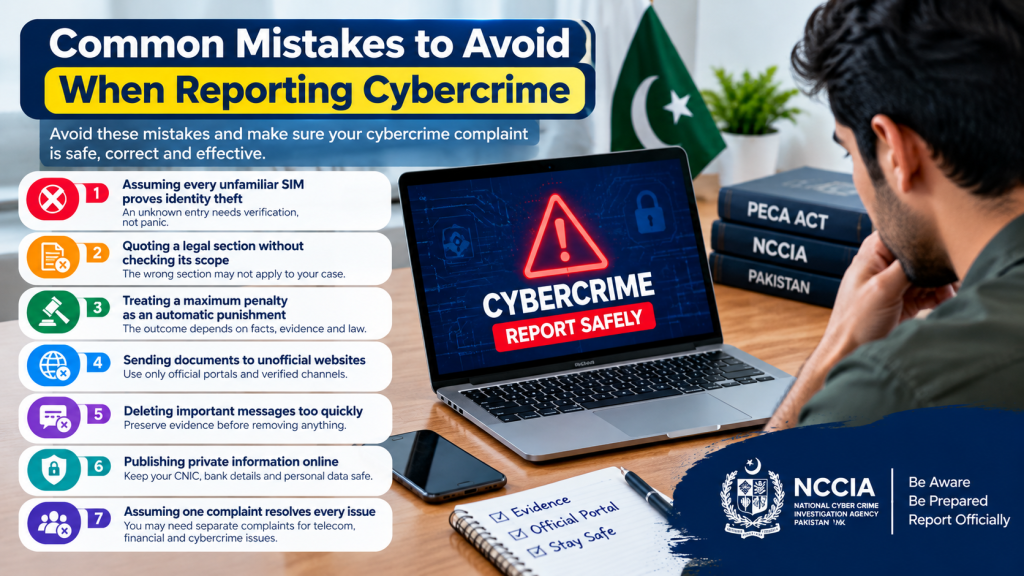
Assuming every unfamiliar SIM proves identity theft
An unknown entry deserves investigation, but the entry alone does not establish the cause or prove a specific offence.
Quoting a legal section without checking its scope
A section number copied from an old article may be inaccurate or may not apply to the incident. Describe the facts and consult the current statutory text.
Treating a maximum penalty as an automatic punishment
The maximum penalty stated in a provision does not mean every complaint leads to that sentence. Legal outcomes depend on the applicable law, evidence and proceedings.
Sending documents to unofficial websites
Avoid third-party sites promising private subscriber details, guaranteed legal outcomes or special access to cybercrime records. Use official portals and verified contact details.
Deleting important messages too quickly
If you suspect a crime, preserve relevant material before removing messages or resetting an account, where it is safe and practical to do so.
Publishing private information online
Do not publicly share your complete CNIC, bank details, account recovery codes or another person’s private information to seek help.
Assuming one complaint resolves every issue
A telecom registration dispute, financial account problem and suspected cybercrime may require separate steps with different organisations.
Frequently Asked Questions About PECA Act Pakistan 2026
1. What is the PECA Act in Pakistan?
The Prevention of Electronic Crimes Act, 2016, is a law addressing specified offences involving information systems and electronic activity. It was amended in 2025. The current statutory text should be consulted to understand the provision relevant to a particular incident.
2. Which agency investigates cybercrime under the amended PECA framework?
NCCIA identifies itself as the authorised agency for inquiries, investigations and prosecutions under PECA. Its official website provides complaint information and reporting-centre details. <Cite refs={[“turn439807search3″,”turn439807search4”]}/>
3. What should I do if an unknown SIM appears against my CNIC?
Check your own registration information through the official PTA SIM Information System, contact the relevant mobile operator to verify the entry, and retain the complaint reference. If the circumstances indicate possible identity misuse or cybercrime, consult the appropriate official reporting channel.
4. Does an unknown SIM automatically mean a PECA offence has occurred?
No. The entry is a discrepancy that requires verification. Whether a particular offence occurred depends on the facts, the relevant legal elements and the available evidence.
5. What is the difference between Sections 16 and 17 of PECA?
Section 16 addresses specified unauthorised use of identity information. Section 17 addresses the unauthorised issuance of SIM cards and related modules without the prescribed subscriber verification. The applicable section depends on the actual conduct. <Cite refs={[“turn439807search6″,”turn439807search2”]}/>
6. How can I submit a cybercrime complaint?
NCCIA’s official FAQ lists its complaint portal, the Pakistan Citizen Portal, email and visits to Cybercrime Reporting Centres among the reporting methods. Check the latest official instructions and documentation requirements before submitting a complaint. <Cite refs={[“turn439807search3”]}/>
7. Can overseas Pakistanis report cybercrime?
NCCIA’s official FAQ provides guidance for overseas complainants, including arrangements involving a focal person in Pakistan. Since procedures can depend on the circumstances, consult the current official instructions before preparing your submission. <Cite refs={[“turn439807search3”]}/>
8. Does a cybercrime complaint guarantee that an investigation or prosecution will succeed?
No. A complaint reports an allegation for consideration; it does not establish guilt or guarantee a particular outcome. The handling of a case depends on the facts, evidence, applicable law and relevant procedure.
Official Sources for Further Reading
Use these official resources to verify current information:
- NCCIA official website: https://www.nccia.gov.pk/
- NCCIA cybercrime complaint portal: https://complaint.nccia.gov.pk
- Official Gazette of Pakistan, PECA Amendment Act 2025: https://na.gov.pk/uploads/documents/679b243193585_457.pdf
- PTA SIM Information System: https://cnic.sims.pk/
For a legal dispute, verify the current statutory text and consult a qualified Pakistani lawyer where individual advice is needed.
Final Thoughts
Understanding PECA can help people respond more carefully when they encounter suspected online fraud, identity misuse, unauthorised SIM registration or other digital-security concerns.
The most important steps are to establish what actually happened, preserve authentic evidence, contact the organisation responsible for the affected service and use the appropriate official reporting channel.
A SIM registration discrepancy should be verified with the relevant operator. A suspected cybercrime should be reported through the applicable official process. Where more than one issue exists, separate complaints may be necessary.
Protect your identity, keep accurate records, verify the law and act on evidence rather than assumptions. These principles provide a practical starting point for dealing with digital-security concerns in Pakistan.
Leave a Reply